
Mesa County Clerk of Court Role
The Clerk of Court for Mesa County operates within the Colorado Judicial Branch at the Mesa County Justice Center. The office supports District Court and County Court case filing, docketing, records retrieval, copy requests, collections routing, and public counter service for court matters. Its work covers court case records such as felony criminal files, misdemeanor files, civil pleadings, divorce and domestic relations records, probate PR matters, juvenile case routing where public access is allowed, traffic case records, judgments, orders, and hearing records.
This office should not be confused with the elected Mesa County Clerk and Recorder. Mesa County's CORA request page states that county open-records requests are for county records only and that court cases, including divorce cases and criminal cases, are not kept by Mesa County. That sentence is the cleanest rule for routing requests. Court case documents go to the Court. Recorded deeds, liens, marriage licenses, and county agency records go to the county side.
Mesa County Clerk of Court
Mesa County Justice Center
125 N Spruce St.
P.O. Box 20,000-5030
Grand Junction, CO 81501
970-257-3640
mesa.court@judicial.state.co.us
Clerk's Office Monday-Friday 7:30 a.m.-4:30 p.m.
Mesa County Court Case Documents
Mesa County court records are searched and requested through state Judicial Branch channels. The docket search is useful for hearing dates, court type, case class, party searches, attorney searches, and case-number components. It is not a full document download database. The record/document request form is the route for copies of divorce decrees, parenting plans, support orders, petitions, pleadings, orders, judgments, probate documents, and other court documents that can be released.
The Mesa County court page also gives practical filing limits for self-represented litigants. Emailed pro se documents must be legible, complete, signed, include a case number if filed into an existing case, be PDF or Word files, and include ID where required. JPGs, photos, and screenshots are rejected. Emailed documents are not considered filed until the filer receives a response that the document was sent to the data entry desk. Domestic relations filings and fee-waiver requests have separate limits, so ask the clerk before treating email as a filing method.
Request Mesa County Certified Copies
A certified copy is a court copy that carries the clerk's certification that it is a true copy from the court record. Certified copies are often needed for divorce decrees, name changes, custody orders, judgments, probate orders, and other uses where an uncertified printout is not enough. The research did not locate a Mesa-specific certified-copy fee, so requesters should ask the clerk for the current copy and certification cost before submitting payment.
- Identify the case type, case number, party names, and document name if known.
- Search the Colorado Judicial Branch docket if the case number or hearing context is missing.
- Use the Judicial Branch record/document request form for releasable court documents.
- State whether a certified copy is required, not just a plain copy.
- Wait for the clerk's fee quote, release decision, and delivery instructions.
- Use the County Clerk and Recorder only for recorded documents, not court case certification.
The statewide Colorado Judicial Branch record/document request form is the official form path for court documents.
Mesa County Court Request Fields
The Judicial Branch record/document request form asks for information that helps the clerk find the correct case and document. A vague request for "all records" is harder to process than a request that names the court, county, parties, case number, date range, and exact document. Family matters have their own document choices, which matters for divorce records because a decree, parenting plan, support order, separation agreement, and petition are different documents.
| Field or Section | Required | Notes |
|---|---|---|
| County | Likely required | Select Mesa for local cases, or use the unknown county option if needed. |
| Date of Birth | Optional if known | Format shown in research was MM/DD/YYYY for the primary party. |
| Party information | Required | Names on the case help the clerk match the file. |
| Other identifying information | Optional | Case number, court, judge, dates, and details improve the search. |
| Requested documents | Required | Select document choices or explain the document under Other. |
| Family matters | Optional | Examples include Divorce Decree, Parenting Plan, Separation Agreement, Support Order, and Petition. |
| Other document text | Optional | Use when the form choices do not name the exact record. |
Mesa County Clerk of Court Fees
The research file located county CORA fees but did not locate a Mesa-specific court copy fee schedule for plain copies, certified copies, certification, or court-record searches. That distinction matters because county CORA fees are not the same thing as Judicial Branch court-record copy fees. Ask the Clerk of Court for the applicable court fee before mailing payment or requesting a certified decree.
| Item | Amount or Rule |
|---|---|
| Court case document copy | Fee not located in official sources inspected |
| Certified court copy | Fee not located in official sources inspected |
| Certification fee | Fee not located in official sources inspected |
| Court record search fee | Fee not located in official sources inspected |
| Mesa County CORA copies | $0.25 per page, but county CORA is not for court cases |
| Mesa County CORA staff time | $30 per hour after the first hour, but not a court-copy fee |
Note: The county CORA fee data is included only to show why court case requests should not be priced from county-record rules.
Mesa County CORA Excludes Court Cases
Colorado Open Records Act requests to Mesa County are for county-government records. They can be useful for county agency documents, but the county form gives a direct warning that records for court cases, including divorce and criminal cases, are not kept by Mesa County. The Court must be contacted directly for copies of court records. That exclusion also keeps probate case files, civil pleadings, and District Court orders on the Judicial Branch side.
The county CORA payment page belongs to the county records process, not the Mesa County Clerk of Court copy desk.
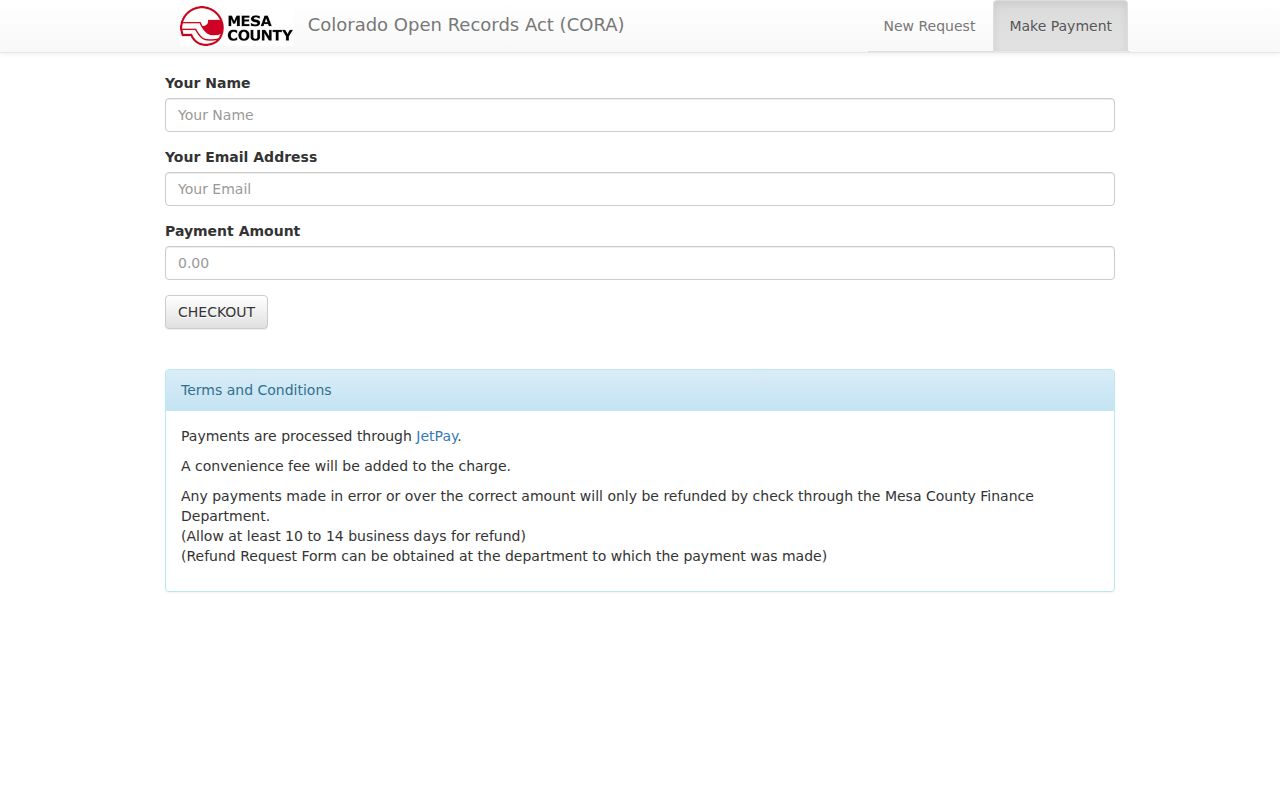
The payment page is relevant only as a boundary: court case documents should be requested from the Judicial Branch clerk.
Clerk of Court vs County Clerk
Mesa County's split clerk structure sends two very different record types to two offices. The Clerk of Court handles court case files at the Justice Center. The County Clerk and Recorder, led by Bobbie Gross, handles Recording, marriage and civil union licensing, elections, motor vehicle, liquor and marijuana licensing, and Clerk to the Board functions. A person searching for recorded instruments should use the County Clerk and Recorder page rather than the court clerk.
Several manifest images assigned to this page show the county recording system, which is not the court case system. The Mesa County Recording Department page is a county-recording source, not a court-copy source.
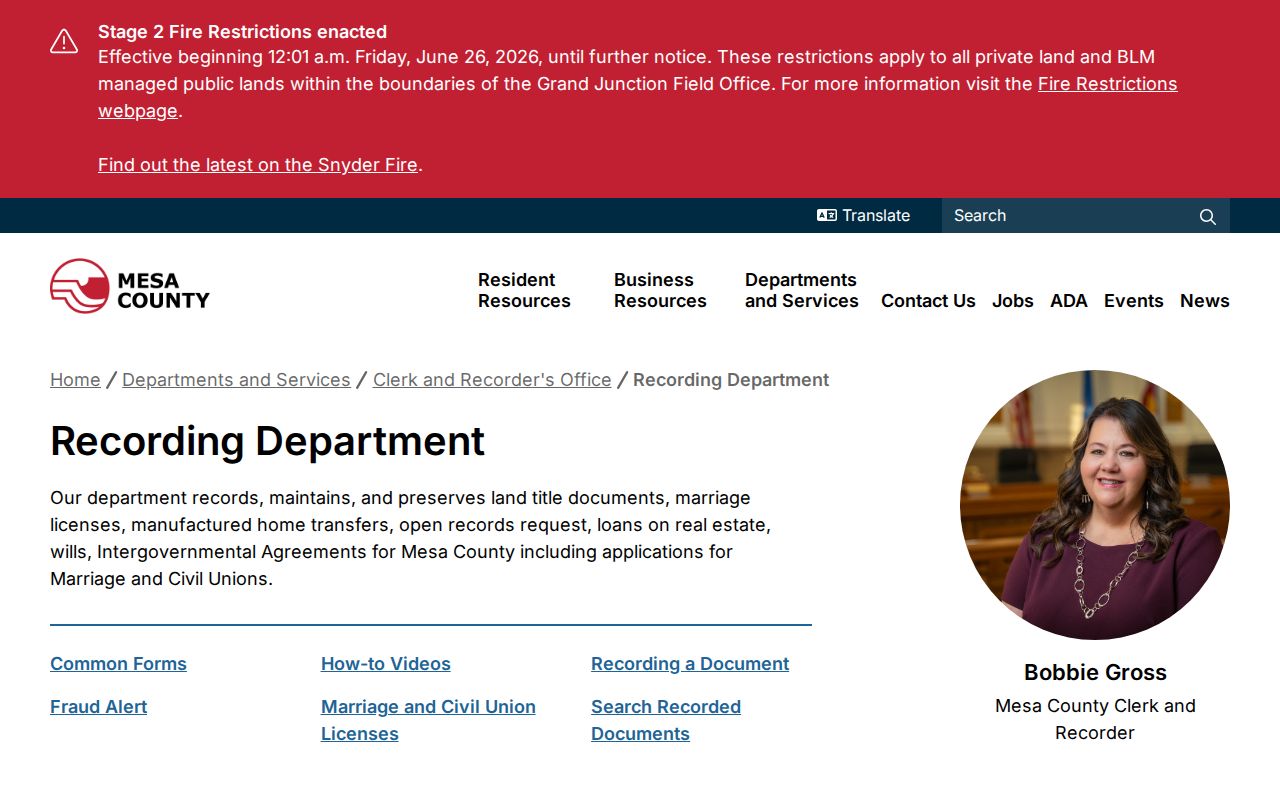
Recording Department information is useful when a requester has deeds, liens, or licenses, but it does not replace the Clerk of Court for case files.
The Mesa County recorded document search page belongs to recorded instruments, not court pleadings.
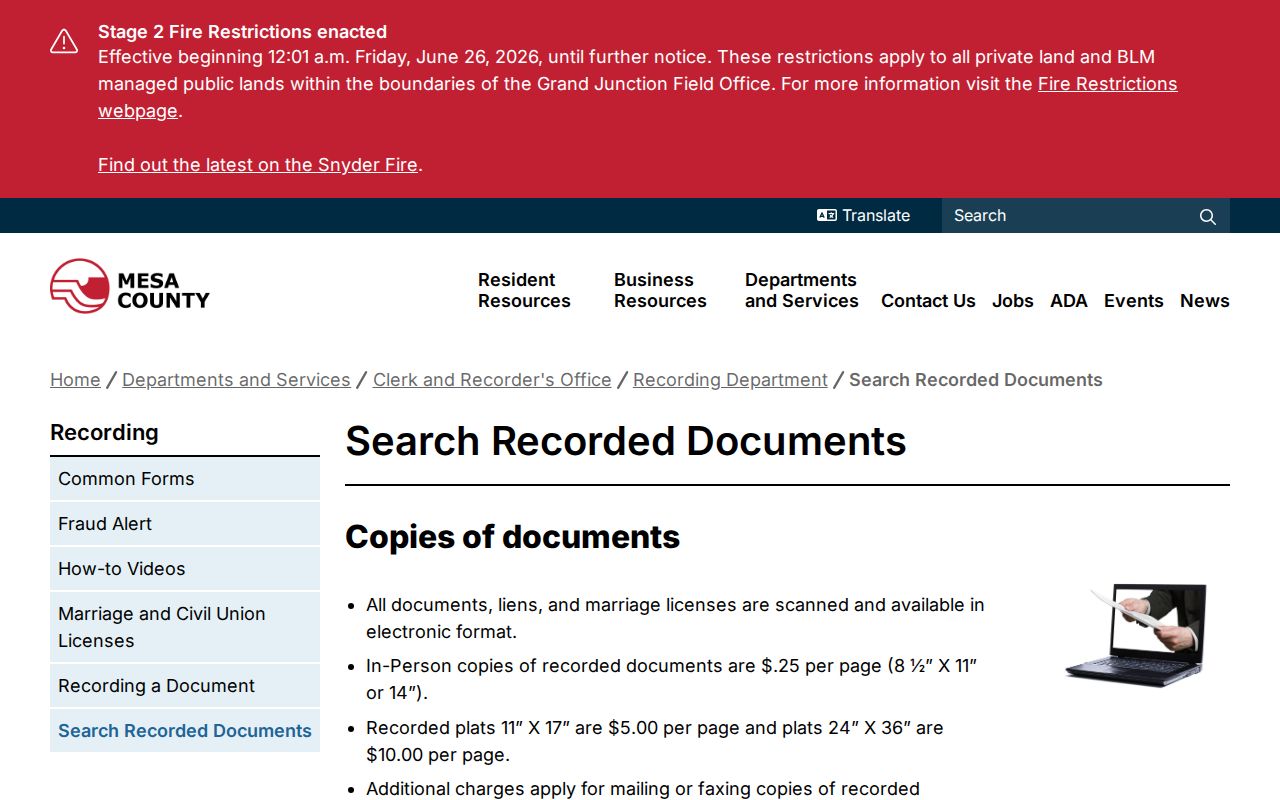
Recorded document search is the wrong channel for pleadings, orders, judgments, and divorce decrees.
The Landmark logon is a county official-records account path, not a Judicial Branch account path.
Landmark account features support county official records, while court document access remains with the Judicial Branch.
The Landmark alpha index is another recorded-document index path.
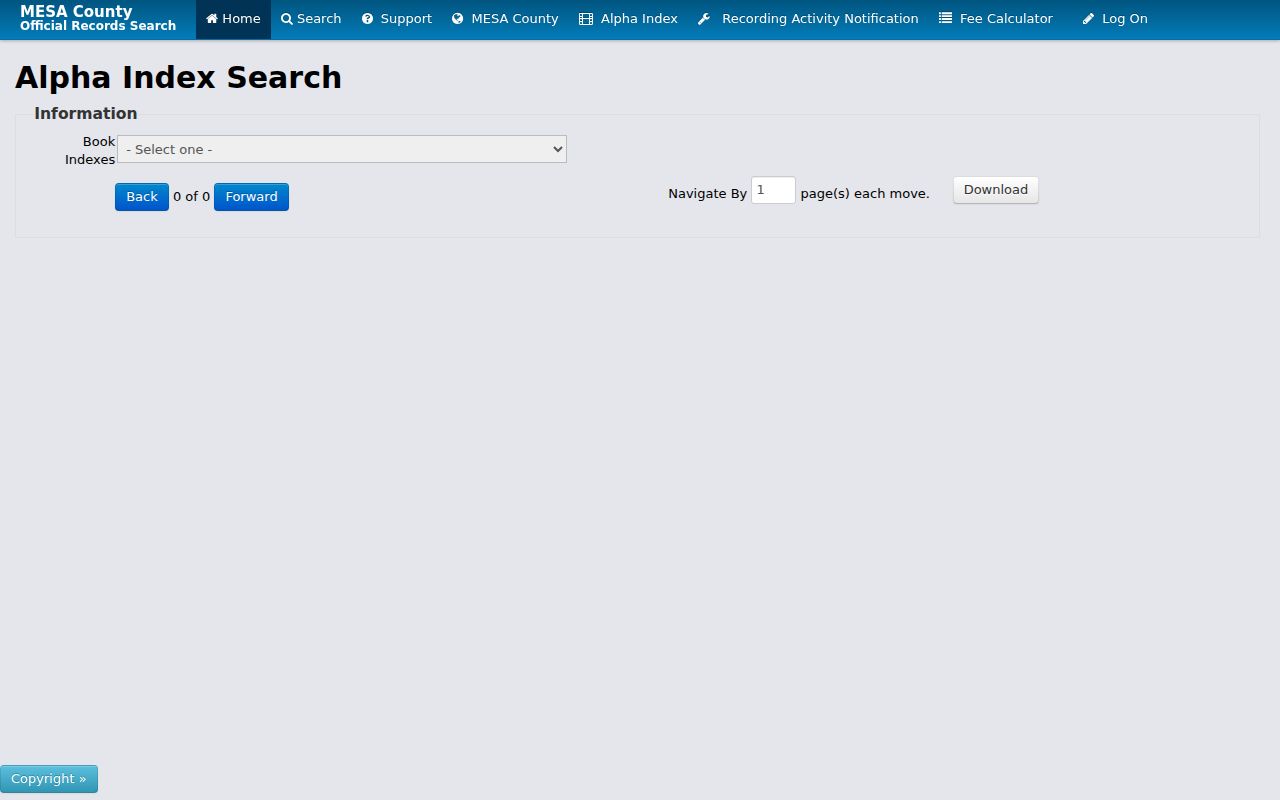
The alpha index can help with recorded instruments, not District Court or County Court case documents.
The recording activity notification tool is a county recording alert.
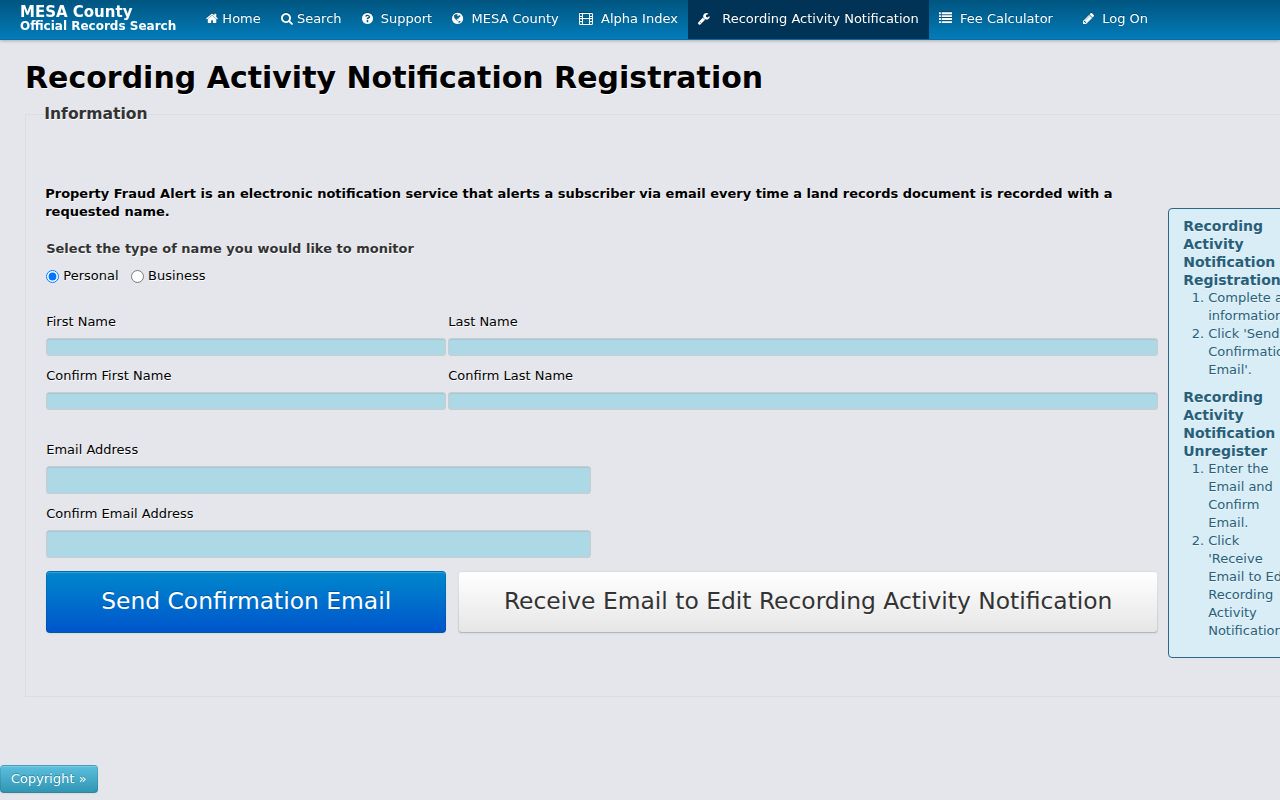
Recording activity alerts are fraud-prevention tools for recorded instruments and should not be read as court docket notices.